

Caffeine and Menopause: Why You’re Waking Up at 3 A.M
What the research says about caffeine, sleep, and why your body responds differently after menopause
If you are over 50 and going through menopause, you may have noticed that caffeine hits differently than it used to. That morning coffee or matcha you have enjoyed for years might now be leaving you wide awake in the middle of the night, even though you drank it hours earlier. You are not imagining it. There is a real biological reason this happens, and the research explains it clearly.
What Caffeine Does in Your Body
Caffeine is a natural stimulant found in coffee, matcha, tea, energy drinks, soda, and even chocolate. It works by blocking a brain chemical called adenosine, the chemical that builds up while you are awake and makes you feel sleepy over time. When caffeine blocks adenosine, you feel alert. But adenosine does not disappear. It keeps building up in the background, waiting for the caffeine to wear off.
According to the U.S. Food and Drug Administration, up to 400 milligrams of caffeine per day, roughly two to three 12-ounce cups of coffee, is considered safe for most healthy adults. But how long caffeine stays in your body varies widely from person to person, and menopause changes the equation significantly.
Why Caffeine Lingers Longer After Menopause
Your liver uses an enzyme called CYP1A2 to process caffeine. Research published in Breast Cancer Research via NIH confirms that this same enzyme is also responsible for processing estrogen, meaning caffeine and estrogen are processed through the same system. When estrogen drops during menopause, that system slows down. Researchers found that CYP1A2 activity declines during menopause, and that the decline is directly tied to falling estrogen levels. The practical result: caffeine stays in your bloodstream longer than it did before menopause.
The NIH notes that caffeine’s half-life, the time it takes your body to clear out just half of it, averages about 5 hours, but can be as long as 9.5 hours depending on the individual. That means a cup of coffee at 7 a.m. could still have caffeine circulating in your body well into the evening.
What Caffeine Does to Your Sleep
Sleep is not one long, continuous state. According to the National Heart, Lung, and Blood Institute, your body moves through cycles of about 80 to 100 minutes all night long. Each cycle includes lighter sleep, deep sleep, and REM (dreaming) sleep. The National Institute of Neurological Disorders and Stroke explains that the deep, slow-wave sleep — the most physically restorative kind — happens mostly in the first half of the night. By the second half of the night, deep sleep is naturally winding down and REM sleep takes over.
Caffeine disrupts this in two important ways. First, research published in the Journal of Sleep Research shows that caffeine directly suppresses deep sleep by blocking the adenosine your brain needs to generate it. Second, a study published in Science Translational Medicine found that caffeine delays your body’s release of melatonin — the hormone that signals it is time to sleep — by roughly 40 minutes. Together, these two effects chip away at deep sleep across the entire night.
A meta-analysis pooling data from 24 studies found that caffeine reduced total sleep time by 45 minutes on average and cut deep sleep duration by 11 minutes. The researchers concluded that to avoid sleep disruption, caffeine should be consumed at least 8.8 hours before bedtime — and for higher-caffeine drinks, even earlier.

Read about caffeine consumption benefits
Why You Wake Up at 3 or 4 A.M.
Here is where it all connects. As your body approaches morning, it naturally starts producing cortisol — a hormone that helps you wake up. Research published in PMC/NIH shows cortisol begins rising as early as 2 to 3 a.m. A controlled study published in Frontiers in Neuroscience found that cortisol levels start to surge around 2:00 a.m. to 3:00 a.m. in study participants. If caffeine is still circulating in your system when that cortisol rises — which is entirely possible if you had caffeine in the morning and your body processes it slowly — the combination can push you fully out of sleep right in that window.
And because deep sleep is already naturally scarce in the second half of the night, as documented in the Journal of Clinical Sleep Medicine, caffeine does not need to cause a dramatic disruption to eliminate it entirely. What little deep sleep remained in the second half simply disappears.
One Editor’s Experience — and What the Data Showed
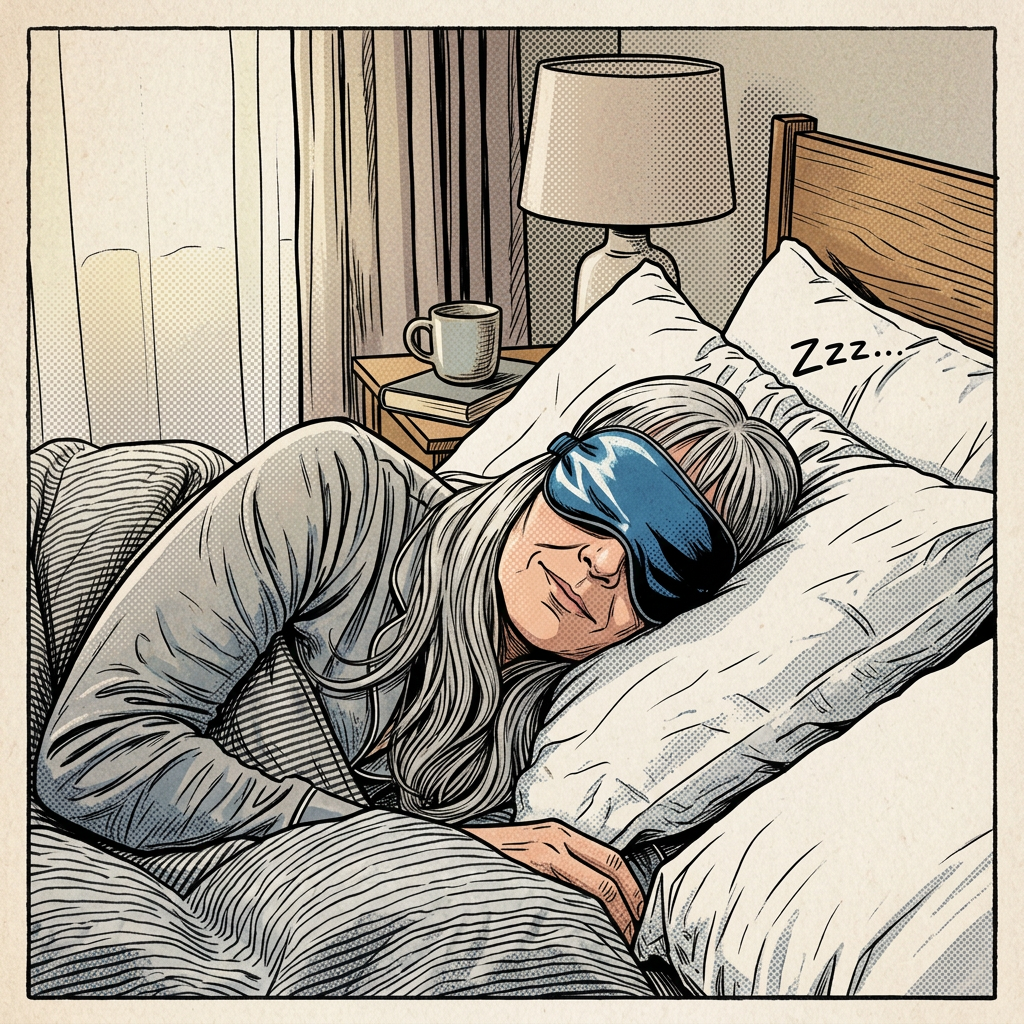
Anecdotally, The Marigold Woman editor-in-chief noticed, after going through menopause, that drinking any caffeine, even first thing in the morning, consistently led to waking up between 3 and 4 a.m., lying awake for at least an hour, and feeling tired the next day. On caffeine-free nights, sleep was deep and uninterrupted. Tracking with her Oura ring made the difference impossible to ignore: her sleep scores were in the low 90s (out of 100) on caffeine-free nights, dropping to the mid-70s on caffeine nights, with no deep sleep recorded in the second half of caffeine nights at all. While her experience was not part of a clinical study, it mirrors what the research predicts.
A large-scale study using data from the National Health and Nutritional Examination Survey found caffeine use was associated with nighttime awakenings, difficulty staying asleep, and daytime sleepiness in adults. A controlled study in the Journal of Clinical Sleep Medicine found measurable sleep disruption even when caffeine was consumed 6 hours before bed — suggesting that for sensitive individuals, no amount of “early enough” may be early enough.

Take the anonymous menopause symptom survey and see compiled results instantly.
Why Menopause Makes It Worse
During menopause, caffeine is not just adding a problem. It is amplifying a vulnerability that already exists. Add hot flashes to that picture and the compounding effect becomes clear: a Mayo Clinic survey of more than 1,800 women found that caffeine users reported more bothersome hot flashes and night sweats — meaning that for women whose sleep is already being interrupted by hot flashes, caffeine may be making those interruptions more frequent and more intense. If you are waking up multiple times a night, it may not be one thing causing it. It may be caffeine, hot flashes, and shifting hormones all working against you at the same time.
What You Can Do About It
- Move your cut-off earlier than you think. Research suggests caffeine should be consumed no more than 8 to 9 hours before bed. If you go to sleep at 10 p.m., that means stopping by 1 p.m. at the latest — and many women in menopause find they need to stop even earlier.
- Track it. Write down when you have caffeine and how you sleep that night. The pattern often becomes very clear, very quickly.
- Use a wearable to track your sleep. A sleep tracker can reveal patterns you might otherwise miss — like consistently lower sleep scores or lost deep sleep on nights that follow a caffeine day. The data has a way of making the connection undeniable. Our editor swears by her Oura ring for exactly this reason.
- Cut back gradually. Stopping suddenly can cause headaches. Swap one drink a day for decaf and reduce slowly.
- Know that decaf is not caffeine-free. An 8-ounce cup of decaf still contains 2 to 15 milligrams of caffeine — worth knowing if you are sensitive.
Talk to Your Doctor: Discussion Checklist
- ☐ Could caffeine be causing or worsening my middle-of-the-night wake-ups?
- ☐ Is caffeine affecting my deep sleep specifically?
- ☐ Should I adjust my caffeine habits if I am on hormone therapy?
- ☐ Am I getting enough calcium and vitamin D for bone health?
- ☐ Would keeping a sleep and caffeine diary help identify my triggers?
- ☐ Could caffeine interact with any medications I currently take?
The Bottom Line
Caffeine is not the enemy. But during menopause, your body processes it more slowly, your sleep is already more fragile, and the window between “fine” and “awake at 3 a.m.” gets much narrower. The good news is that this is one of the more controllable pieces of the menopause sleep puzzle. You do not have to give up caffeine entirely. But paying attention to how much you have, and how early you stop, can make a real difference in how you sleep — and how you feel the next day.
If you are tracking your sleep and noticing a consistent pattern on caffeine days, trust what the data is showing you. Your body is not overreacting. It is telling you something worth listening to.
Share your experience and tips in the comments below or at The Marigold Woman Facebook Group. Don’t forget to sign up for our newsletter to stay up-to-date with our latest post!
Further Reading & References
General Resources
- Menopause Information – The Marigold Woman Website
- Sleep Problems and Menopause: What Can I Do? — National Institute on Aging
- How Much Caffeine Is Too Much? — U.S. Food & Drug Administration
- Menopause Overview & Treatment — U.S. Office on Women’s Health
- Patient Resources — The Menopause Society
Caffeine & Sleep Research
- Caffeine and Sleep — Sleep Foundation
- Stages of Sleep — Sleep Foundation
- Sleep Stages — National Heart, Lung, and Blood Institute (NIH)
- Brain Basics: Understanding Sleep — National Institute of Neurological Disorders and Stroke (NIH)
- Caffeine Pharmacology — NIH/NCBI Bookshelf
- Caffeine and Sleep: A Meta-Analysis of 24 Studies — PubMed/NIH
- Caffeine Effects on Sleep Taken 0, 3, or 6 Hours Before Going to Bed — Journal of Clinical Sleep Medicine, PMC/NIH
- Slow-Wave Sleep Distribution Across the Night — Journal of Clinical Sleep Medicine, PMC/NIH
- Adenosine, Caffeine, and Sleep-Wake Regulation — Journal of Sleep Research, PMC/NIH
- Caffeine Delays Melatonin Onset — Science Translational Medicine, PMC/NIH
- Caffeine Use and Self-Reported Sleep Disturbance — National Health and Nutritional Examination Survey, PMC/NIH
- Cortisol and the Circadian Wake Cycle — PMC/NIH
- The Cortisol Awakening Response — Frontiers in Neuroscience, PMC/NIH
Caffeine, Menopause & Hormones
- CYP1A2 and Estrogen/Caffeine Metabolism — Breast Cancer Research, PMC/NIH
- CYP1A2 Activity Decline During Menopause — Frontiers in Pharmacology
- Caffeine and Menopausal Hot Flashes & Night Sweats — Mayo Clinic News Network
- Caffeine and Menopausal Symptoms: What Is the Association? — Faubion et al., Menopause, PubMed/NIH
- Caffeine: How Much Is Too Much? — Mayo Clinic
This post was researched and drafted with the assistance of AI. All sources were reviewed and verified to the best of their ability by the editorial team.
Disclaimer: This blog is intended for informational purposes only and should not be considered legal or medical advice, diagnosis, or treatment. We strongly encourage readers to conduct their own research and consult with a qualified healthcare professional before making any decisions or changes to their health and medical routines. Marigold Brands and The Marigold Woman cannot be held accountable for any inaccuracies or adverse outcomes related to the information presented. We strive to provide accurate and up-to-date information. However, medical knowledge is constantly evolving, and individual experiences may vary. Sources and references are provided to support the content and enable readers to further explore topics and do not imply endorsement. Always consult with your healthcare provider before making significant changes to your health routine.


Leave a Reply